U2 "Street of Dreams": Lyrics Meaning & Spanish Chorus Explained
The meaning of "Street of Dreams" by U2 is hope with an address. The band's first single from their upcoming album - their first full record of new songs in nine years - is an anthem about not giving up on your dreams, and on paper that sounds as general as it gets.
What grounds it is where the song lives: Mexico City, sung partly in Spanish, written in the orbit of a football tournament for street children. The street of dreams isn't a metaphor here. U2 stood on it.
Released on July 7, 2026, the song arrives two months before the band's 50th anniversary - and it sounds less like a victory lap than a mission statement.
What is "Street of Dreams" about?
Perseverance, told from street level. The verses move through fate, trust and fear like obstacles on a route - your fate, you'll fight it; this bus, you'll ride it - toward a destination where, as the chorus insists, all the doors are open. There's a prayer in the middle of it: the narrator calling out to God from far from anywhere, down to the last breath of air. Classic Bono territory — the anthem and the plea in the same song.
The line that gives the song its weight is the chorus's second half:
"Broken are the chosen on the street of dreams"
That inversion is the whole idea: the broken aren't the ones left behind on this street - they're the chosen ones. Read against the song's origin, it stops being a platitude and becomes a portrait.
What does "La calle, calle de los sueños" mean?
The song's bilingual hook opens every chorus:
"La calle, calle de los sueños"
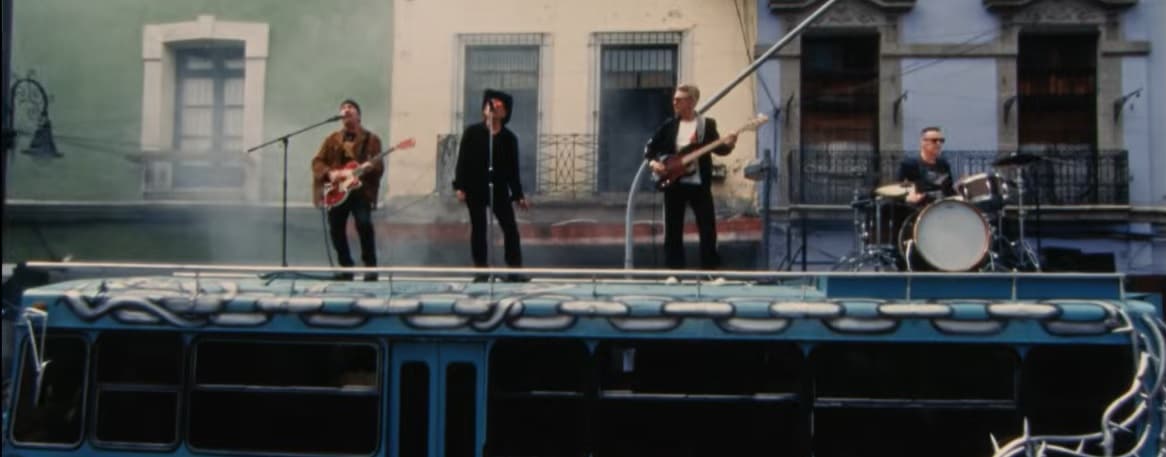
Bono sings the chorus in both languages throughout - Spanish first, English answer - which ties the Mexico City setting into the song's DNA rather than using it as a backdrop. Even the bus the band performed on in the video carried the Spanish title, painted across its side by Mexican artist Chavis Mármol.
For a band that has spent five decades writing about streets - most famously the ones with no name - the choice is pointed: this street has a name, a language and a location.
The real street behind the song
Here's the story that anchors the lyrics. In May, U2 traveled to Mexico City to attend the finals of the 2026 Street Child World Cup - a football tournament for children who live and work on the streets - and to shoot the song's video in the city's historic center. The shoot itself became a small legend: the band performed on top of a graffitied school bus at Plaza de Santo Domingo, a thunderstorm crashed their generator, and a local family invited all four members onto their apartment balcony to keep filming.
Read the lyrics through that lens and they sharpen. "Broken are the chosen" over footage of street children playing football isn't motivational-poster language - it's advocacy. The song about not giving up on your dream for the many, not just the few, was road-tested on the street it describes. And while this summer's other World Cup is producing anthems of its own, U2 wrote one for the tournament nobody televises.
There's a band-history layer too: drummer Larry Mullen Jr., who missed U2's entire Sphere residency recovering from neck surgery, is back on the record - the man who founded the band with a note on a school noticeboard 50 years ago, playing on a song about refusing to quit.
How it sounds - and what critics say
Produced by longtime collaborator Jacknife Lee (How to Dismantle an Atomic Bomb, Songs of Experience), the track is built on The Edge's chiming guitar and a rolling snare pattern - deliberately, unmistakably U2. Reviews split along a familiar line: some hear a band sounding comfortable in its own skin, showing restraint where a younger U2 would have reached for bigger crescendos; others find Bono's lyrics lofty and general, with lines like the closing chant - break out, break through, your dream needs you - landing closer to platitude than poetry.
Both readings are fair, and the song almost invites the argument. Bono himself framed the upcoming album as "unreasonably colorful" rock & roll as an act of resistance - after two somber EPs this year (Days of Ash and Easter Lily), "Street of Dreams" is the pivot from lament to defiance. Whether defiant hope reads as inspiring or generic has divided U2 listeners for about 45 years now.
Quick answers
What is "Street of Dreams" by U2 about?
Not giving up on your dreams - grounded in the band's involvement with the Street Child World Cup in Mexico City. The recurring image of broken people as the chosen ones ties the anthem to the children the tournament serves.
What does "la calle de los sueños" mean?
It's Spanish for "the street of dreams" - the song's bilingual chorus, reflecting its Mexico City origins.
Is "Street of Dreams" on a new U2 album?
Yes - it's the first single from U2's yet-untitled new studio album, expected later in 2026: their first all-new LP since Songs of Experience (2017).
When is U2's 50th anniversary?
September 2026 - fifty years after drummer Larry Mullen Jr. posted a handwritten note on a Dublin school noticeboard looking for musicians to form a band. U2 are among the very few major bands from that era with their original lineup fully intact.
Who produced "Street of Dreams"?
Jacknife Lee, the longtime U2 collaborator who co-produced How to Dismantle an Atomic Bomb and Songs of Experience.
What "Street of Dreams" really means
The meaning of "Street of Dreams" depends on whether you hear it with its context attached. Without it, it's a well-made U2 anthem about hope - sturdy, chiming, general. With it, the street gets coordinates: a real city, real kids, a real tournament for the children pop songs usually gesture at abstractly. "Broken are the chosen" is either a platitude or a promise, and U2 spent a week in Mexico City arguing for the second reading. Fifty years in, that's still the band's core move: taking the biggest, vaguest words in pop - dream, street, love - and trying to pin them to the ground somewhere specific.
Further Reading